Jazz posters: the golden age of Paris clubs
Jazz posters: from Josephine Baker to the clubs of Saint-Germain, the golden age of swing in 8 moods to hang on your wall.

Key points
- 14 posters in the Jazz posters collection, all in the table below.
- From 18,55 € in A4, up to 69,95 € in A0, 5 sizes for each poster.
- Printed in the Netherlands on demand, free delivery from 59 €.
The table
The 15 posters at a glance


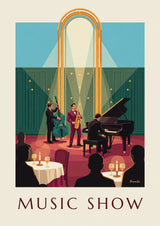

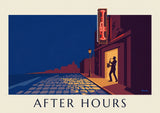


When Sidney Bechet arrived in Paris in 1925, jazz was not yet 20 years old. He would make Saint-Germain-des-Prés his stage. The jazz posters of that era capture an unrivaled fervor: smoky cellars, saxophonists in silhouette, fringed dresses and dimmed light.
The Hot Club de France, founded in 1932, became the headquarters of a generation. Django Reinhardt and Stéphane Grappelli formed the Quintette there, and Charles Delaunay wrote the world’s first serious jazz discography. A visual Art Deco grammar was born, made of golden saxophones, silhouetted trumpets and deep black backgrounds.
Our selection draws on this palette. Ideal for a music lover’s office, a reading nook or a living room in dark tones. Matte black framing or a thin brass edge recommended.
Keep exploring

Jazz posters, the golden age of swing and Paris clubs
Parisian jazz from the 1930s to the 1950s produced a distinctive iconography: Saint-Germain-des-Prés, the Caveau de la Huchette, the Tabou, the concerts of Sidney Bechet and Boris Vian. The advertising posters of that era distill a nocturnal, intellectual, free-spirited Paris that left its mark on French cultural imagination. Today, these posters suit grown-up, lively interiors that love music.
The golden age of jazz in Paris (1920-1950)
Paris became Europe’s jazz capital between the wars. Joséphine Baker at the Bal Nègre, Sidney Bechet on rue de Lappe, Django Reinhardt at the Hot Club de France: the clubs of Saint-Germain-des-Prés, Montmartre and Pigalle welcomed the greatest American musicians and created a unique French scene.
The legendary clubs and their posters
The Caveau de la Huchette, Le Bal Nègre, Le Trianon, Le Bœuf sur le Toit: each club had its own posters signed by the great illustrators of the day. They featured hand-drawn lettering, a black, gold and red palette, and silhouettes of saxophonists or pianists in stylized flat color.
Stylized instruments in illustration
Saxophone, trumpet, double bass, piano: each instrument becomes a strong graphic sign. Our jazz posters treat these instruments as Art Deco silhouettes in a golden palette on a deep background. An A3 portrait print looks great above a dresser or sideboard.
Iconic musicians
Sidney Bechet, Stéphane Grappelli, Django Reinhardt, Boris Vian: the figures of French jazz. Our posters show them as anonymous silhouettes (an instrument and a hat rather than a precise portrait), so they stay accessible to all audiences. The palette is midnight blue, gold and red.
Swing and the aesthetics of the 1940s
Swing-era paintings, 1940s dresses, Manhattan cocktails: jazz calls for a coherent aesthetic world. Our jazz posters pair naturally with our classic cocktail and corkscrew posters. It’s a great way to create an evening-mood wall.
How to create a jazz wall for a living room or office
Start with 3 posters: a single instrument (sax, A3 portrait), a club scene (A2 landscape) and a typographic detail (lettering, A4). All three share a golden palette. It makes an ideal gallery wall above a dining room sideboard or in a reading nook.
Classic jazz art leans into deep palettes (black, gold, midnight blue) that evoke the feel of a club. Best suited to living rooms, dining rooms and home bars; less ideal for bedrooms.
Browse our full jazz collection and our music collection. You might also like: the history of the French advertising poster.




Build this wall
3 posters from this article, at true scale


All 3 posters: 99,85 €
Frequently asked questions
You often ask us
Which jazz subjects work as posters?
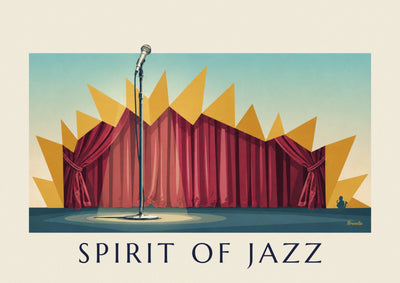
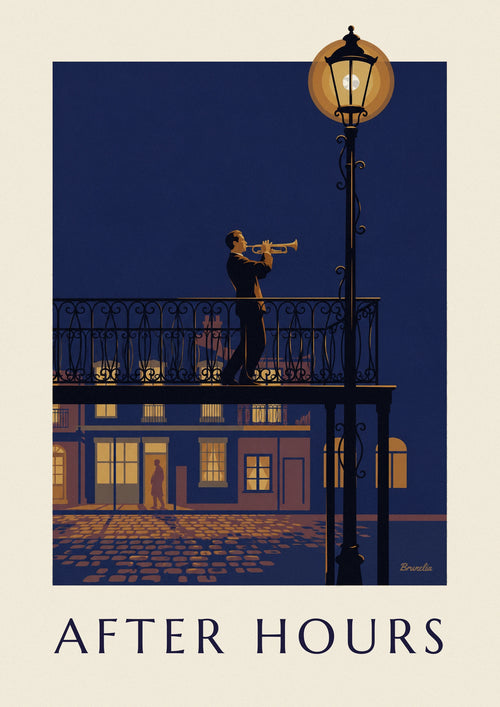
Club musicians (saxophonist, double bassist, pianist, drummer, trumpeter on a balcony), scenes under the spotlights, a lone microphone in front of the curtain, a neon sign and a brass band marching through the streets of New Orleans.
Which colors suit a jazz poster?
Deep black, burgundy red, midnight blue, gold, off-white. 5 understated, nocturnal colors that evoke the clubs.
Which size for a jazz poster?
Vertical format (A1 or A2) for musician portraits. Landscape format for club scenes. Ideal for an office, an adult living room or a wine bar.
Which frame for a jazz poster?
Matte black with a gold inner trim for glamorous subjects, or plain matte black with no gold for more serious subjects. A frame 2 to 3 cm wide.
What mistakes should you avoid with a jazz poster?
Modern imitations that look dated. Photos that feel flat. Flashy cabaret subjects that belong to another world.
Keep exploring